Throwing BIG


The other month myself, alongside Sophie Lever, one of the very talented artists-in-residence at the Worcester Center for Craft, threw big pots on the pottery wheel.
It was a fun challenge, and to be honest, it makes me want to make more big pots. My pot, made from cone 10 stoneware (bmix with grog), started with 24lbs of clay, though I probably lost around throwing 2lbs with a few uneven pulls and by doing a simple trim whilst wet. This was, by far, the most clay I’ve ever thrown with. Prior to this, I’ve thrown around 16lbs max. At the end of the day, my pot ended by being 10in tall and 17in wide at the rim.
I threw this pot on May 28, and have since let it dry veerrryyy slowly. In this time I have trimmed it and sat with it, debating whether or not I should fire it. It’s not perfect. I’m sure I can do better next time. And it is a lot of clay to not be fully satisfied with. That being said... it is currently sitting on the shelves at my local community studio awaiting a bisque fire. Once it comes out of the bisque, I intend to do some surface decoration with underglaze. I’m not sure how I’ll decorate it exactly, but I have a lot of surface area to act as my canvas and I’m excited to have some fun with it. I’ve been experimenting with abstract acrylic paintings as of late, so I’m contemplating going abstract with my underglazes. This piece doesn’t have to be perfect, heck, it doesn’t even have a purpose yet! This piece is an experiment. I think it is important to challenge yourself, experiment and play when making. Isn’t that in part why we make anyway? Right now my making practice is a blend of thoughtful planned out works ( @ my ceramic function sculptures), and intuitive experiments pieces (this piece, my acrylic paintings, etc.), and I’m having fun with both avenues. I’m curious to see how they merge together down the line.
But anyway! What’s next in big pot land you ask? Probably some more throwing large amounts of clay to see how big I can get the pots, and also probably some other large pot throwing methods in the future. Other techniques I hope to try at some point are sectional throwing, stacking wet pots (both are essentially throwing multiple pots, some without bottoms, and then attaching them together), and adding on big coils as I throw. All of these will require me to leave my walls thicker than I typically do.
But until I get to experiment more with all this, I’ll leave you with a few brief notes and tips about throwing big that I gathered from this first foray:
Brace your wrist! I don’t know about you, but I know when I’m throwing anything over 8lbs of clay there is a good chance I’m going to cause my wrist some pain if I am not consciously thinking about properly bracing it/my muscles to reduce chance of injury. For me, the best way to brace is to firmly dig my elbows into my body. The area where my thighs meet my torso, right at my hips is a great spot for me. By doing this I’m able to apply pressure using the full force of my body, not just my arm or wrist strength. This is both protecting myself from injury as well as helping me center more efficiently.
Know your shape. I find whenever I don’t have a good idea of what shape I want to make - big or small - my work is never 100% satisfactory. If I create a simple line sketch I’m able to visualize easier, and my hands don’t second guess as much. It also helps me know when I want to collar, how tall I want certain sections, and when to pull the clay outward.
Stiffen up your clay on your wheelhead. When throwing big, sometimes your clay can get too wet which will reduce it’s structural stability. To combat this you can use a heat gun to help dry out your clay and stiffen it a bit before you continue. I also like to let my clay stiffen with either a heat gun or by leaving it on the wheel head for a bit while I clean up after I finish throwing my pot. If my walls are thin, or any part is wobbly, the jerky motions that can occur as you remove the piece/bat from the wheelhead can cause it to warp, distort or fold in on itself. Letting the pot dry a bit (and having it on a bat) reduces this possibility.
Slowwwww dry. We all know it. We all lack the impatience to do it often. But a slow dry is going to reduce warping, and allow the pot to dry evenly which can help prevent cracking. When throwing with a large amount of clay, this becomes important because we don’t want to fire it too quickly, have it warp too much or crack and then waste 20+lbs of clay. In this economy? I don’t think so.
Thanks for reading! And I challenge you to throw a bit bigger, and play a little more this week! ❤️

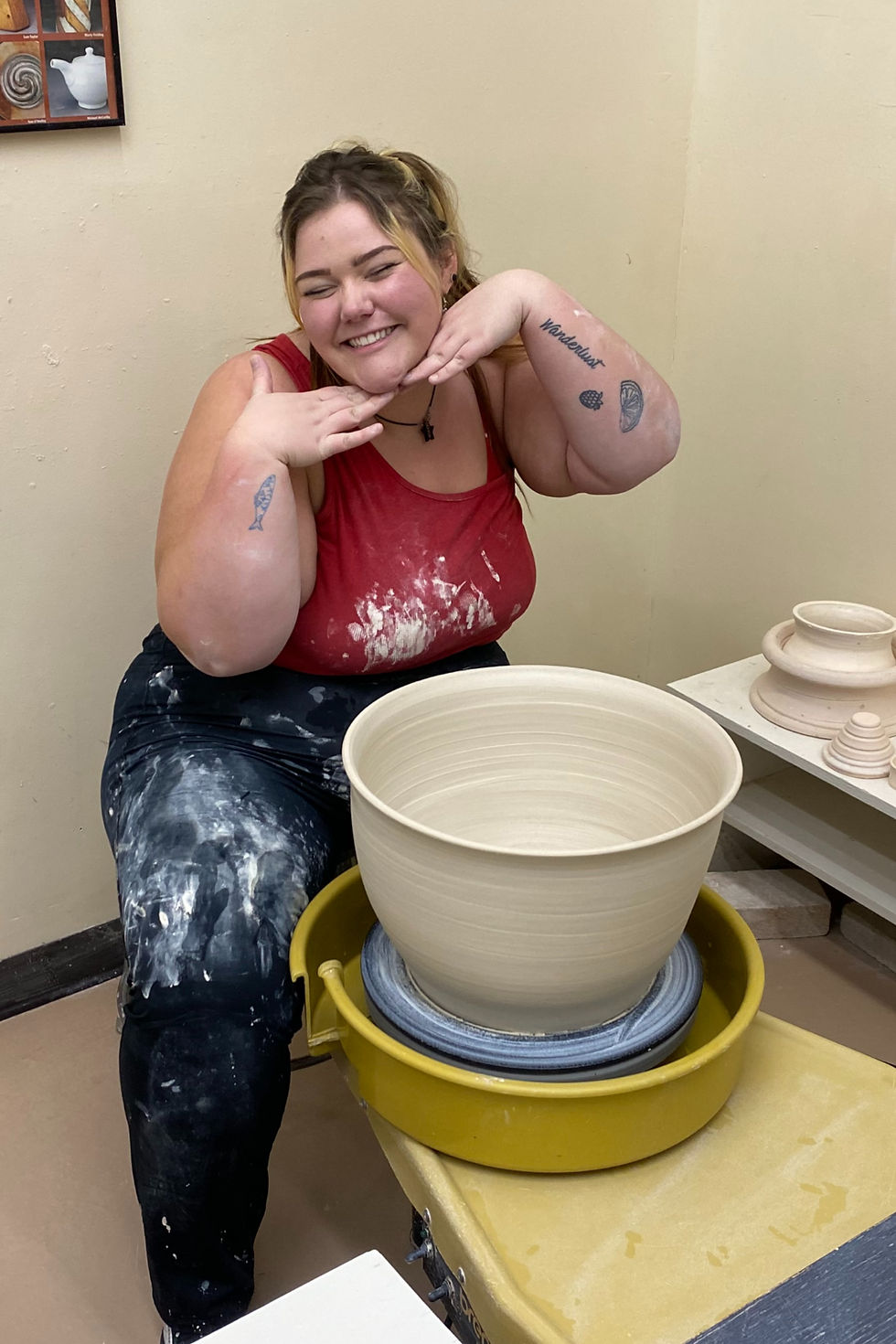
Feel free to comment below if you have any tips for throwing big, or if you are working on any cool big projects yourself!


Comments